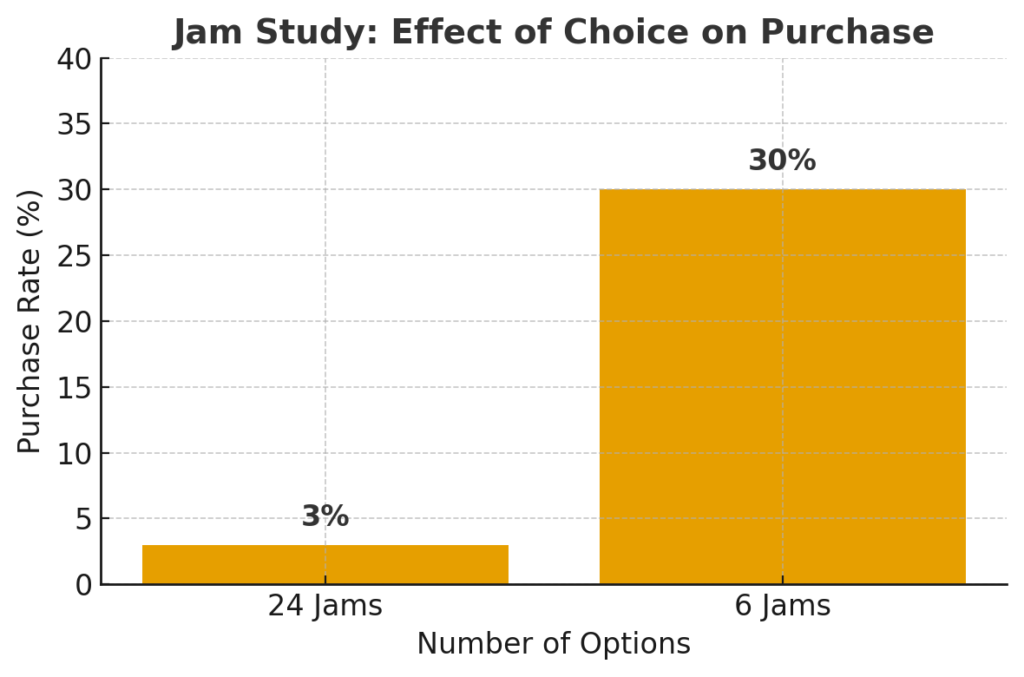
Barry Schwartz – The Paradox of Choice (2004)
Too much choice blocks.
Shoppers faced with abundant SKUs often feel anxious, delay decisions, or regret their purchase.
Don’t overlook the book’s subtitle: “Why more is less?
In retail, more is not always better — abundance can lower conversion.
A common situation is a shopper walking store aisles of the grocery supermarket. On one shelf, six nearly identical yogurts from different suppliers. On another, dozens of energy bars, many duplicates, with slow movers shoved to the back. Shoppers glance, hesitate, and often walk away. Some don’t even come into the store – they walk straight across the street to the discounter with leaner assortment.
It’s only natural that a retail manager asks:
“Which products on these shelves are hurting me more than helping — and how do I know?”
Which SKUs deserve to live — and which are noise?
The path to clarity lies in connecting shopper logic with category purpose.
Assortment optimization must begin with clarity of role and strategy, before SKU decisions.
When role and strategy are explicit, SKU decisions are less ad hoc and more systemic.
Pair that with shopper decision logic (as in the Customer Decision Tree), and your roadmap emerges: for each shopper mission, you know which sub-decisions matter (brand, pack size, feature, price), and which SKUs are indispensable.
Key shopping mision?
Shopping motive that brings the shopper into your store. What are succesfully met expectations?
Why a category lives in your store?
Destination
Routine
Convenience
Image
Seasonal
How each category pulls its weight?
traffic attractor
margin engine
loyalty builder
convenience anchor
Rules for assortment optimization
Breadth
Width
Length
Consistency
In practice, you’d overlay a Role × Strategy matrix, then map the customer decistion tree nodes to that matrix to see which SKUs are critical. e.g.:
Infant formula, baby consumables
must offer breadth and depth across trusted brands—its strategy is traffic & loyalty
cooking oils
might require fewer SKUs, emphasizing consistency, turnover, and margin — strategy is steady sales
premium category
might trade breadth for curated selection, highlighting exclusivity or signature SKUs.
Let’s revisit a Slovenian supermarket chain’s baby category (diapers, formula, accessories) — a category that originally aimed to be a Destination draw. Over time, it got bloated:
Choice overload: multiple near-duplicate SKUs every year, justified by supplier pushes.
Shoppers overwhelmed by choices; experienced parents sometimes turned to specialty baby stores.
Operational inefficiency: Store staff struggled with out-of-stocks while many slow movers clogged shelf space.
Low SKU productivity: Profitable SKUs got buried under the noise of marginal ones. Instead of being a beacon for parents, it became a hassle. The baby category lost its clarity.
That pattern, replicated across many categories, leads to:
Without role/strategy anchoring, each SKU decision is a small gamble. Over time, the bets stack against you.
When your team asks, “Does this SKU support our role-strategy-shopper logic?” the answer becomes obvious, not controversial.
And the clutter dissolves—not by random cuts but by sculpting around shopper missions.
In our Assortment Optimization Workshop retailers bring this to life: they overlay CDT maps on the categories, assign roles & strategies, and make SKU-optimization decisions in guided steps.
The result? Fewer SKUs, clearer shelves, better turnover, and stronger shopper trust.
Take another real life example. During our assortment optimization workshop, we came to a conclusion: streamline toys department in a local supermarket from 19 bays to 6 bays. That’s 70% cut!!!
We could afford this because we applied the shopper logic.
Toys in grocery supermarkets are not a Destination category, but a Routine/Impulse add-on.
Limit breadth and depth, focus on shelf productivity and impulse hit logic!
Parents and children buy impulsively; fewer SKUs make choice easier and increase the likelihood of conversion.
Cut relentlessly low-turning SKUS
-70%
Category Sales
+10,4% UP
Reduced complexity
Easier space management
Clearer presentation
A recommendation list of potential cuts, clearly marked as low risk or high risk based on shopper logic
One of the central trade-offs in assortment optimization is between
breadth: how many different SKUs or variants you offer.
and
depth: how much stock or how many facings per SKU.
Let’s illustrate with yogurt by following highly successful discounters like Aldi and Lidl as an example: they cover breadth by offering key shopper missions—plain natural yogurt, fruit yogurt, Greek style, organic, lactose-free, even sheep- or goat-milk options. Each signals awareness of different shopper needs.
Alexander Chernev – When More is Less and Less is More (2003) Variety can be positive if it is organized and meaningful. Relevant, segmented assortments (good–better–best, clear missions) raise satisfaction and perceived freedom. But cluttered, random assortments undermine confidence and reduce buying likelihood.
But within each segment, they keep depth tightly limited. Instead of six strawberry yogurts across five brands in multiple pack sizes, discounters usually carry one carefully chosen SKU per segment—often their private label.
This creates clarity for shoppers and ensures every facing moves quickly.
The result is not just leaner shelves but also higher turnover and stronger negotiating power. With volume consolidated into fewer SKUs, discounters achieve lower costs, better margins, and the ability to offer aggressive price/value propositions. Shoppers learn they won’t drown in duplicates; they’ll reliably find what they need at the best price.
This strategy demonstrates that assortment optimization isn’t about cutting choice—it’s about curating breadth while limiting depth to make every SKU count. For categories like yogurt, it’s the difference between clutter and clarity, hesitation and purchase.
Assortment optimization is about curating the right mix that matters to your shoppers. The yogurt shelves showed how it works: cover the essential breadth of missions (from plain to organic), but strip away duplicate depth that clutters decisions. But that works as yogurt is a routinely bought category, a staple that reinforces the promise: “You can do your whole shop here.” for different shopper profiles, parents, kids, health-conscious shoppers. Thus it works as routine x traffic driver where traffic leads towards profit driver.
With role and strategy as your compass, assortment shifts from confusion to clarity.
Cluttered shelves slow shoppers down; streamlined ones build trust, turnover, and value. Done right, optimization doesn’t just tidy up your assortment — it becomes a driver of growth and loyalty.
At Omnibus, our workshop model helps teams apply this role–strategy–shopper logic directly to their own categories, using templates and live discussions to make tough SKU choices visible and practical. With Alvin as an AI support, you can test different assortment scenarios in real time—seeing which cuts streamline the shelf without hurting sales. Together, they turn assortment optimization from guesswork into a structured, data-driven, and shopper-aligned process.
Relevant (often leaner) assortments, higher turnover, stronger loyalty.
For more info, explanations & order of the Assortment Optimization Workshop fill the contact form or write me an e-mail simon@omnibus.si!